
Every competitor in the fintech infrastructure market takes one of two approaches. Either they build one layer very well — origination, or servicing, or payments — and tell you to integrate the rest yourself. Or they assemble multiple products into a suite and call it a platform, with the internal complexity that implies.
Metagens.ai is built on a third approach: every layer of the fintech stack — lending, payments, AML compliance, core banking, card issuing, and security — developed natively in a single codebase, deployed as one system, sharing one data model. There is no API between the AML engine and the lending module because they are the same system. No sync delay between the core banking ledger and the card platform because they share the same data store.

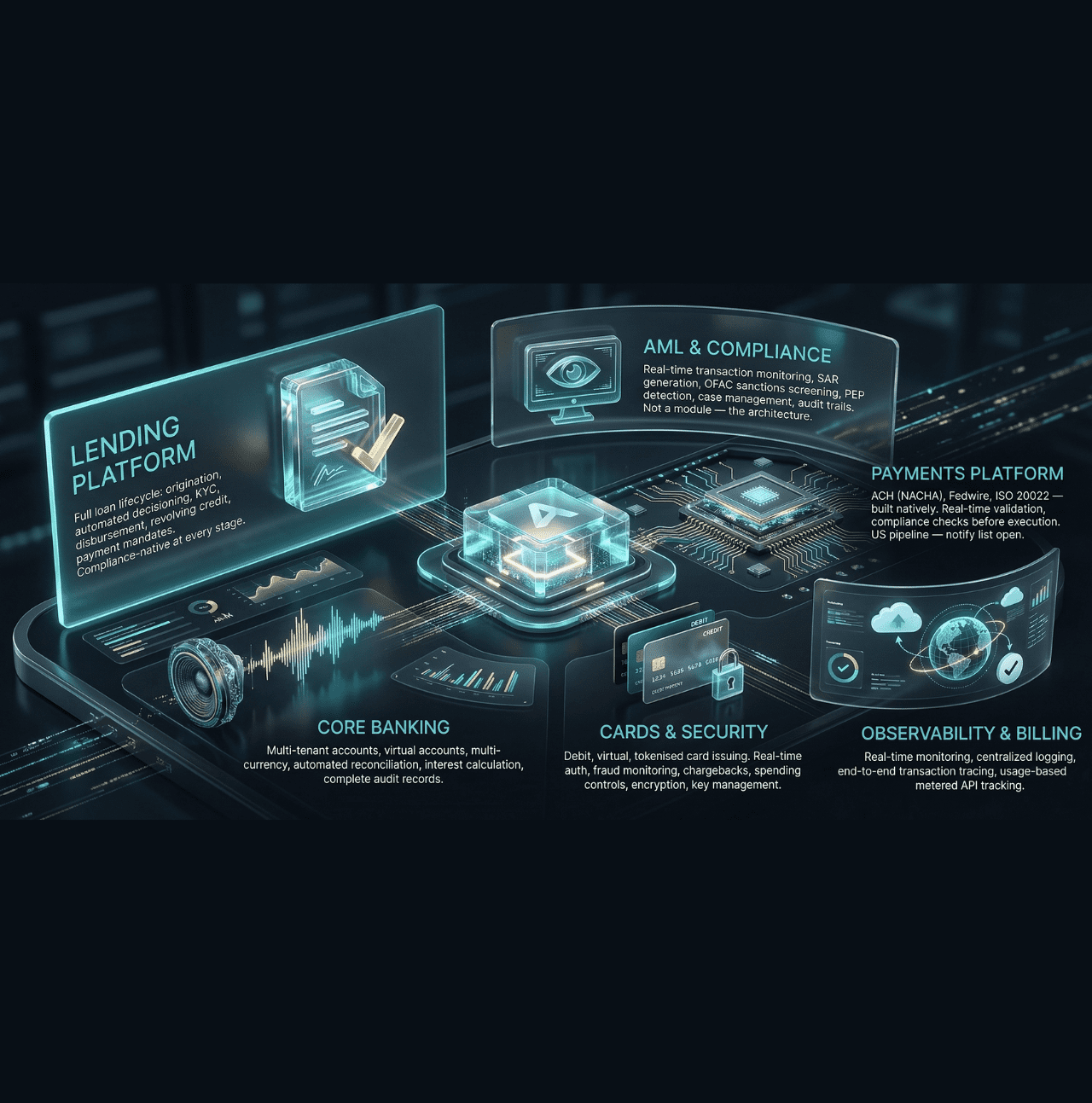
Full loan lifecycle: origination, automated decisioning, KYC, disbursement, revolving credit, payment mandates. Compliance-native at every stage.

Real-time transaction monitoring, SAR generation, OFAC sanctions screening, PEP detection, case management, audit trails. Not a module — the architecture.

ACH (NACHA), Fedwire, ISO 20022 — built natively. Real-time validation, compliance checks before execution. US pipeline — notify list open.

Multi-tenant accounts, virtual accounts, multi-currency, automated reconciliation, interest calculation, complete audit records.

Debit, virtual, tokenised card issuing. Real-time auth, fraud monitoring, chargebacks, spending controls, encryption, key management.

Real-time monitoring, centralized logging, end-to-end transaction tracing, usage-based billing, metered API tracking.

When a loan application triggers an AML check in Metagens.ai, that check does not make an API call to an external compliance engine. It runs in the same transaction, on the same data model, in the same system. The result is returned in real time — not queued, not delayed, not subject to an external SLA.
This is the practical consequence of building a platform natively rather than assembling it from parts. It is also why Metagens.ai can guarantee a 6–8 week full-stack deployment: there is no integration work to scope, no API versioning to negotiate, no compatibility testing between five different vendors.
every financial event recorded once, visible everywhere
layer between compliance and lending data
when the platform updates, all six layers update together
one support escalation path not six separate vendor queues
one pricing structure no ‘per-integration’ costs hidden in the fine print
Yes. Most deployments start with Lending + AML + Core Banking — the modules that share the most data and benefit most from native integration. Cards can be added at any point. The Payments Platform is in the US pipeline; speak to us about your timeline. You pay for what you activate.
It means every module was written as part of the same codebase from the beginning — not acquired, not integrated, not licensed from a third party. The AML engine was not bought from a compliance vendor and integrated into the lending platform. It was built alongside it, sharing the same data structures, by the same engineering team.
Composable banking means you select and assemble the components yourself — from Mambu's catalogue and from third-party partners. The flexibility is real; the assembly overhead is also real. Metagens.ai makes a different tradeoff: less customisation flexibility, dramatically less integration work, faster deployment, and lower total engineering cost. If your team wants maximum module flexibility and has the engineering resources to manage it, composable is a valid choice. If your team wants a full-stack operation live in 6–8 weeks with one vendor to call, Metagens.ai is built for that.
One call. We show you the architecture — not slides about it. 30 minutes, your questions, our answers.


Full-stack fintech infrastructure for teams building lending products in the US market. Lending. AML. Payments. Core Banking. Cards. One deployment. Built native. Not assembled.
Subscribe for new articles on fintech lending infrastructure, AML compliance, and payments architecture. No marketing content. No product announcements. Just the technical insights.